
PARTICIPATORY METHODS FOR DESIGNING SOCIAL TECHNOLOGIES
In April of 2011 I submitted my PhD thesis on design research methods for social technologies. My research was undertaken at the Interaction Design and Human Practice Lab, University of Technology, Sydney and was supervised by Dr Toni Robertson.
The research explored how participation can be understood and facilitated in the design of social technologies.
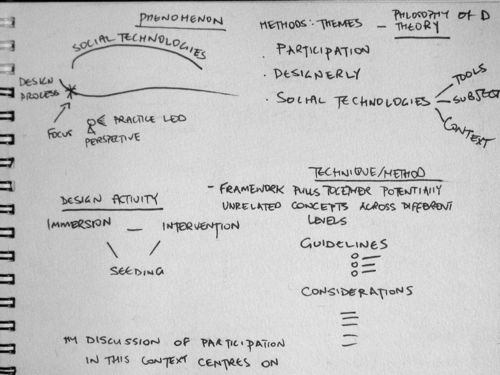
The sketch below captures the key aspects of my research: a practice-led exploration into participation, design and methods in the context of social technologies. The focus is on the qualities introduced by social technologies as tools for generative design research early in the design process. It also explores how social technologies, as subject for design, both demand and enable new approaches to participation that engage the dynamics of design and use inherent to social technologies. The results include key concepts and issues to be sensitive to when designing in this context and a set of conceptual tools, guidelines and strategies for (re-)thinking participation in early design in the context of social technologies.
Below is the title and abstract of my thesis. Download a full version of the final thesis.
The Changing Nature of Participation in Design: A practice-based study of social technologies in early design research
Penny Hagen
A thesis submitted for the degree of Doctor of Philosophy in Computing Sciences
1st April 2011
Interaction Design and Human Practice Laboratory
School of Software, Faculty of Engineering and Information Technology
University of Technology, Sydney
Principal Supervisor: A/Prof Toni Robertson, FEIT, UTS
Co-Supervisor: Dr Lian Loke, FEIT, UTS
ABSTRACT
Social technologies put a new emphasis on participation. This thesis investigates the impact of social technologies on how we enable, conceive and manage participation in early design. The research questions in this thesis address how, and in what ways, using social technologies as design tools can support participation in the early stages of design, and how using such tools creates new opportunities for participation in early design when social technologies themselves are the subject of design. It develops and presents concepts and strategies that account for the sharable, social and participatory nature of social technologies and encourages designers to reconsider how notions of participation are currently embedded and framed within existing design methods and models.
The questions are explored through a practice-based investigation into the use of social technologies as self-reporting tools. Over the course of two field studies a self-reporting method, Mobile Diaries, was iteratively designed, evaluated and implemented in a specific commercial design context. The analysis demonstrated that using social technologies as design tools enhances the capacity for self-reporting to enable participants to contribute to design from the context of their own lives. This greater integration between the activities of research and everyday life blurs some traditional design research boundaries, with ethical and methodological implications for which we are only beginning to account. In addition, when social technologies are the subject of design, using social technologies as design tools creates an experiential connection between the activities of researching, designing and using. This creates new opportunities for participation through use early in the design process that blur traditional boundaries between the activities of research, design and use. Barriers to embracing these opportunities in commercial contexts include the assumption that the activities of design and use progress consecutively and the value of early participation in design is largely embodied in the tangible outputs of design research.
This research extends existing knowledge about the nature of participation in design, and how participation can be supported, through three main contributions:
1. The development of Mobile Diaries, a specific self-reporting method beneficial to early design research and suited to commercial use
2. Conceptual tools that reflect the impact of social technologies on self-reporting and draw attention to the new ethical and methodological implications they introduce
3. Strategies to articulate and support experiences and outcomes important to the early design of social technologies in community settings, through the use of social technologies themselves.
This thesis also makes a fourth contribution that is methodological:
4. It is an example of how practice-based design research can be conducted in a commercial context in ways valuable to both practice and research domains.